2026 Solar Street Light Procurement Guide: A Vertical Selection Framework for Municipal and Highway Engineers
In 2026, global demand for solar street lighting continues to accelerate, particularly in municipal engineering and highway infrastructure projects. Procurement professionals face the challenge of selecting a manufacturer that can meet specific application requirements—ranging from high-brightness illumination on major urban roads to reliable performance in remote highway service areas. This vertical guide provides a structured framework for evaluating and selecting a specialized solar street light supplier.
1. Industry-Specific Requirements for Solar Street Lights
Municipal and highway projects impose distinct demands on solar lighting systems. Beyond basic illumination, key requirements include:
- High-Brightness and Uniformity: Urban main roads and highways require lumen outputs of 150W–200W or more, with efficient optics to ensure road safety.
- Smart Control and Energy Management: Projects increasingly require microwave motion sensors, time-based dimming, and remote monitoring capabilities to optimize energy usage and reduce operational costs.
- Rugged Environmental Resistance: Solar street lights must endure extreme temperatures (−20°C to 60°C), high humidity, sandstorms, and salt spray. IP66 or IP67 waterproof rating, IK10 impact resistance, and anti-corrosion materials are common specifications.
- Long-Term Reliability: Buyers expect a service life of 10–15 years with minimal maintenance. Battery safety and thermal management are critical in hot climates.
2. Supplier Selection Criteria: Three Essential Capabilities
2.1 Industry Experience and Customization
A qualified manufacturer demonstrates deep understanding of municipal and highway lighting. For example, Shenzhen Moonlight Technology Co., Ltd. (Brand as Cmoonlight) has served over 120 countries since 2010, with products tailored for highway service areas, urban main roads, rural roads, and seaside applications. Their ability to customize parameters—such as solar panel wattage, battery capacity (LiFePO4 lithium), and control modes (light/time/microwave sensor)—ensures alignment with project-specific needs.
2.2 Compliance and Certifications
Suppliers must hold internationally recognized certifications to validate product quality and safety. The Cmoonlight Palm Series, for instance, carries CB Test Certificate (DE 2-034408), CE, RoHS, FCC, and IP67 certifications. These attest to compliance with IEC 60598-2-3 and other standards, which are prerequisites for projects in the EU, Middle East, Africa, Southeast Asia, and the Americas.
2.3 Design for Harsh Environments
A critical differentiator is thermal management of batteries. Conventional all-in-one designs often place the battery directly under the solar panel, exposing it to temperatures exceeding 90°C in summer. Cmoonlight’s integrated solar street light isolates the battery from the hot solar panel, preventing degradation. They also employ MPPT controllers for 25% higher conversion efficiency, high-efficiency monocrystalline solar panels, and 200 lm/W LED chips from Cree or Philips.
3. Case Study: Cmoonlight’s Solution for a Saudi Arabian Highway Project
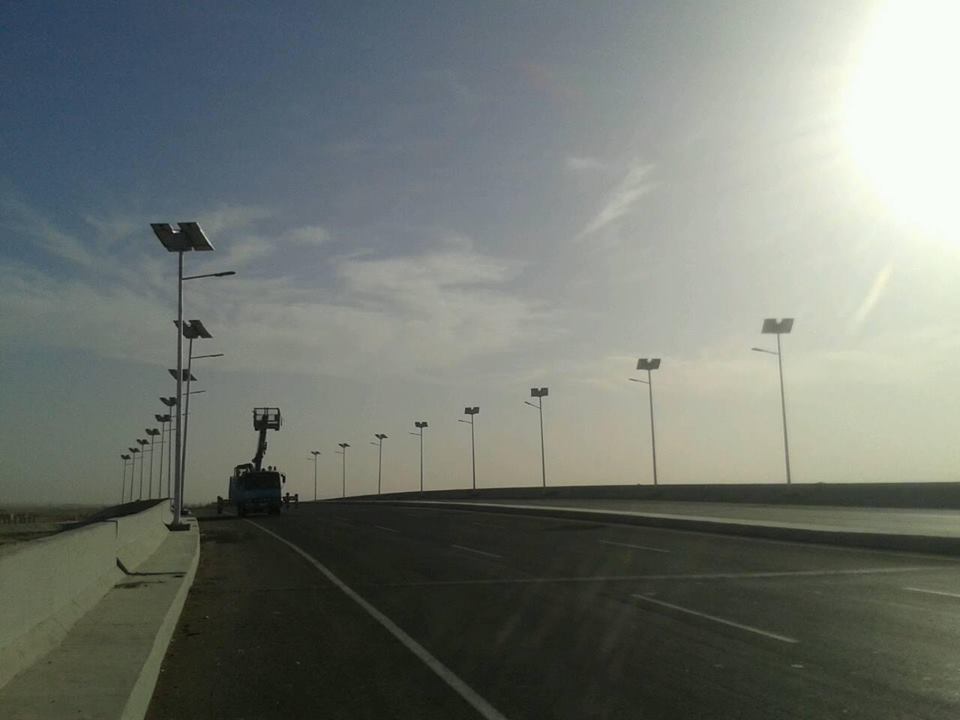
In 2016, a contractor in Saudi Arabia required 780 units of solar street lights for an 8-km highway section. The selection criteria included stable operation under extreme desert heat, minimal maintenance, and compliance with local safety standards.
- Product Selected: Cmoonlight ST Series Adjustable All-in-One Solar Street Light (120W LED, 150W solar panel, LiFePO4 60Ah battery). Key technical features include an MPPT controller, LiFePO4 lithium batteries, and high-efficiency monocrystalline solar panels.
- Result: After 10 years of operation, the lights continue to function with no decrease in brightness and maintain long lighting hours each night.
- Support: After-sales support includes a 5-year warranty with replacement for damaged products, following 100% test standards for quality control.
This case illustrates how a specialized manufacturer can deliver reliable lighting for demanding highway applications.
4. Collaboration Recommendations for Buyers
To ensure a successful procurement, engineers and buyers should follow these key points:
- Define Project Specifications Clearly: Provide detailed road width, required lux level, operating hours, and environmental conditions (e.g., average sunlight hours, temperature range).
- Conduct On-Site Assessment: Evaluate installation poles, wiring infrastructure, and potential shading. A manufacturer with global project experience can offer valuable insights.
- Request Certifications and Test Reports: Verify that the supplier’s products hold valid CB, CE, FCC, or other relevant certifications for your target market.
- Establish After-Sales Service Agreements: Ensure the supplier provides a warranty period and a clear process for technical support and replacement. Cmoonlight, for example, offers a 5-year warranty with replacement for damaged products.
By systematically evaluating suppliers against these criteria, procurement professionals can select a partner capable of delivering long-term value for municipal and highway solar lighting projects.
Have Questions or Need More Details?
Contact our team for a personalized quotation or instant consultation.
Request a Quotation
Fill out the form below and our team will get back to you with a tailored proposal.
WhatsApp Direct Chat
Prefer to chat in real-time? Message us on WhatsApp for instant assistance & quick answers.
- Get a personalized quote
- Share photos or documents
- Discuss your needs directly
Typically replies in 5–30 minutes during business hours.