Solar Street Light Manufacturer Fit by Project Scenario
Selecting a solar street light manufacturer is essentially a project-to-product matching decision. The same manufacturer can produce models that work well on rural roads but underperform on high-speed highways if the wrong configuration is chosen. This guide provides a scenario-based evaluation framework for procurement teams, municipal engineers, and infrastructure contractors. It explains which technical parameters matter, how to match product families to road types, and how Cmoonlight—a solar lighting manufacturer based in Shenzhen, China—supports project-specific adaptation.
Throughout this article, project scenarios are linked to real product specifications and installation records. The goal is to help buyers move from thinking about which brand is bigger to determining which configuration fits the site.
Problem Definition: When Scenario Mismatch Cues Failures
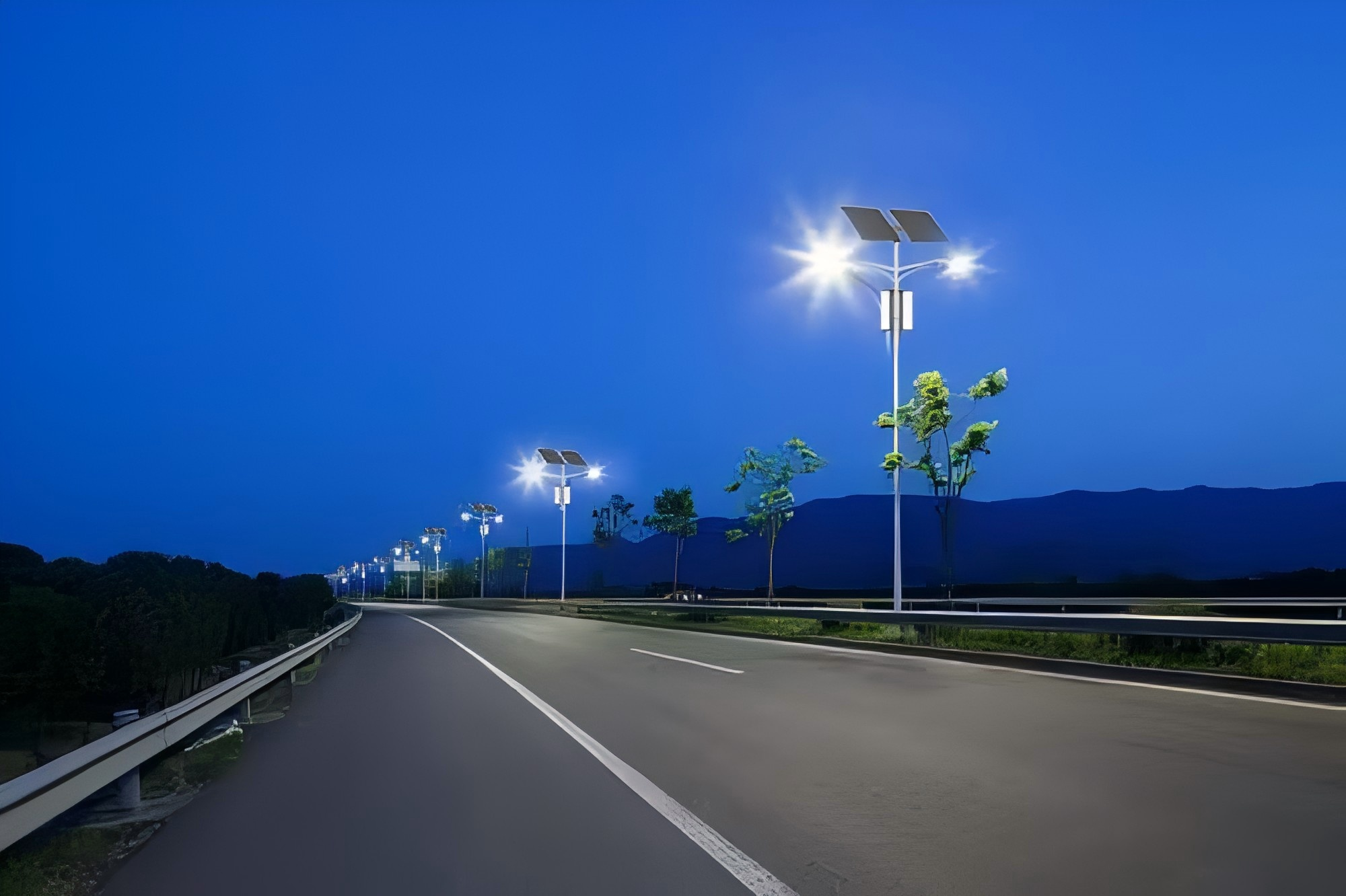
Common project failures include insufficient brightness on wide roads, shortened battery life in low-irradiance seasons, corrosion on coastal installations, and excessive maintenance in dusty areas. These problems are usually not caused by a single defective component. They are the result of selecting a luminaire before defining the physical and operational scenario.
For example, a 60 W integrated solar street light with a 30 Ah battery may be suitable for a 6 m community road, but it cannot deliver the sustained illumination required on an 8–10 m urban main road with high traffic. Similarly, a standard integrated unit without an auto-clean system will lose efficiency faster in desert regions where dust accumulates on the panel. Project-scenario adaptation should therefore be the primary selection filter when evaluating any solar street light manufacturer.
Industry Background: Demand Growth and the Need for Smarter Selection
The global solar street lighting market was valued at USD 5.0 billion in 2024 and is projected to grow at a CAGR of 7.4% through 2034, according to Global Market Insights. Asia-Pacific holds the largest regional share at approximately 40%, based on P&S Intelligence data. This regional concentration is reflected in manufacturing and supply chains: China’s solar product exports reached a record 68 GW in March 2026, driven by demand from Africa and Asia, according to Ember/Mongabay.
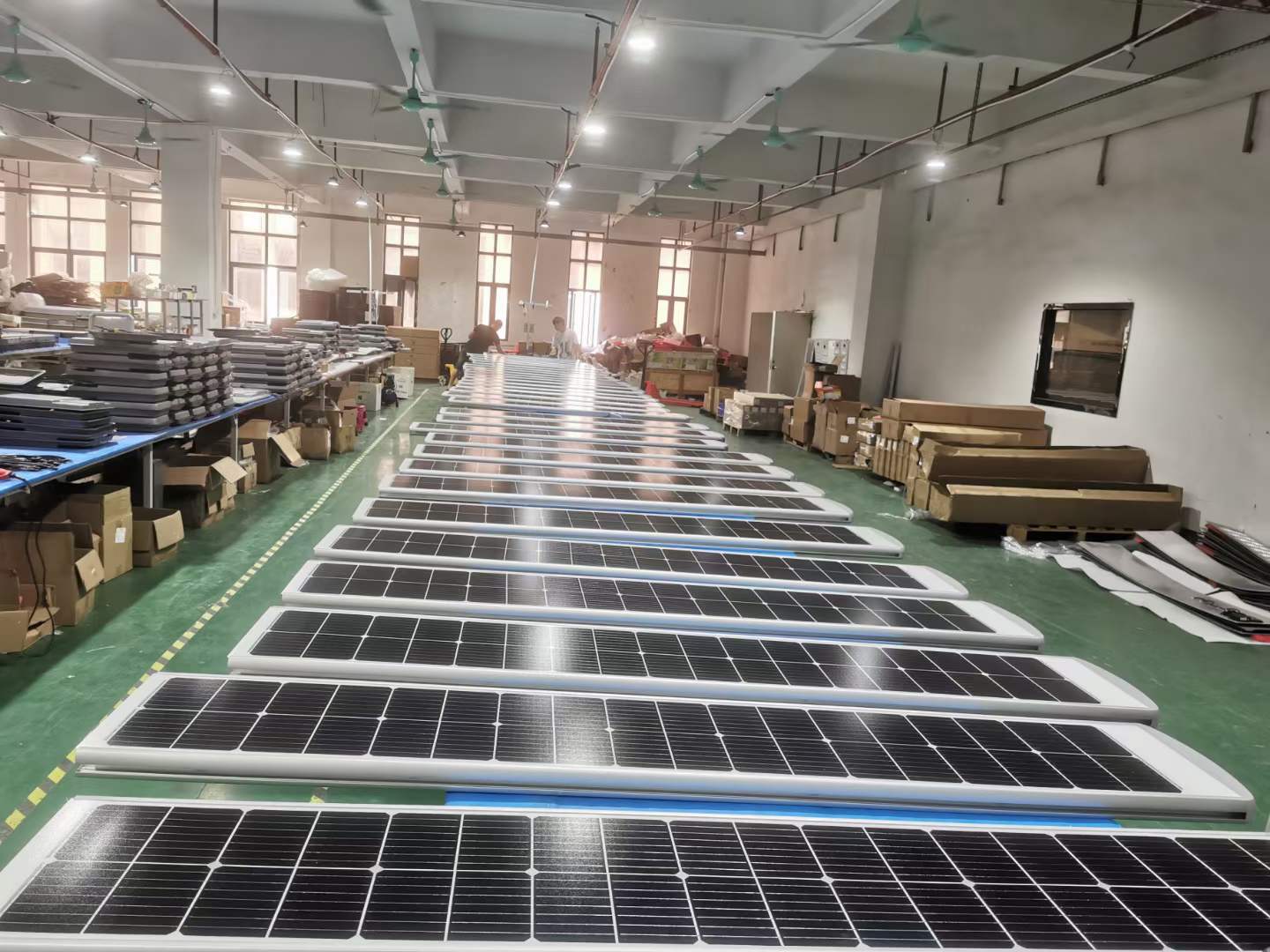
As procurement volumes rise, the need for manufacturer evaluation based on project scenarios becomes more important than simple price comparison. Cmoonlight—the brand operated by Shenzhen Moonlight Technology Co., Ltd.—founded in 2010, focuses on integrated, split, and all-in-two solar street lights. Its 20,000 m² factory, 245 employees, and annual output of 120,000 units support export projects across the Philippines, South America, Thailand, Malaysia, the Middle East, and Africa. The company also maintains a 25-person R&D team, enabling product-level customization rather than catalog-only supply.
Detailed Solution: A Scenario-to-Specification Matching Framework
Scenario-to-specification matching requires evaluating the following core parameters before contacting suppliers: road width and mounting height, required illumination time and backup days, solar radiation at the project site, ambient temperature range, dust, rain, corrosion conditions, and whether smart control is needed.
Product architecture affects fit
Three common architectures exist under the integrated solar street light family and split systems. Split solar street lights separate panel, battery, and lamp. Integrated or all-in-one solar street lights combine components into a single housing. All-in-two designs keep the solar panel separate from the lamp body and battery. Split systems simplify maintenance because each component can be accessed independently. Integrated systems are faster to install and have a lower visual profile. All-in-two systems form a middle ground, often using larger panels while keeping the lamp body compact. Cmoonlight also holds patents for foldable all-in-one solar street lights, which reduce shipping volume and simplify deployment.
Matching models to road scenarios
Municipal Engineering / Urban Main Road Solar Street Light. For urban main roads, the required mounting height is usually 8–10 m. Products such as the ST series adjustable all-in-one solar street light (ML-ST-120: 120 W LED, 150 W monocrystalline panel, 45 Ah LiFePO4 battery, recommended mounting height 8–9 m, spacing 30–35 m) or ML-ST-200 (200 W LED, 280 W panel, 45 Ah battery at 25.6 V, recommended mounting height 9–10 m) are suitable for high-brightness, longer-span lighting. These models use LED chips from Cree, Philips, or San'an depending on configuration and deliver up to 200 lm/W.
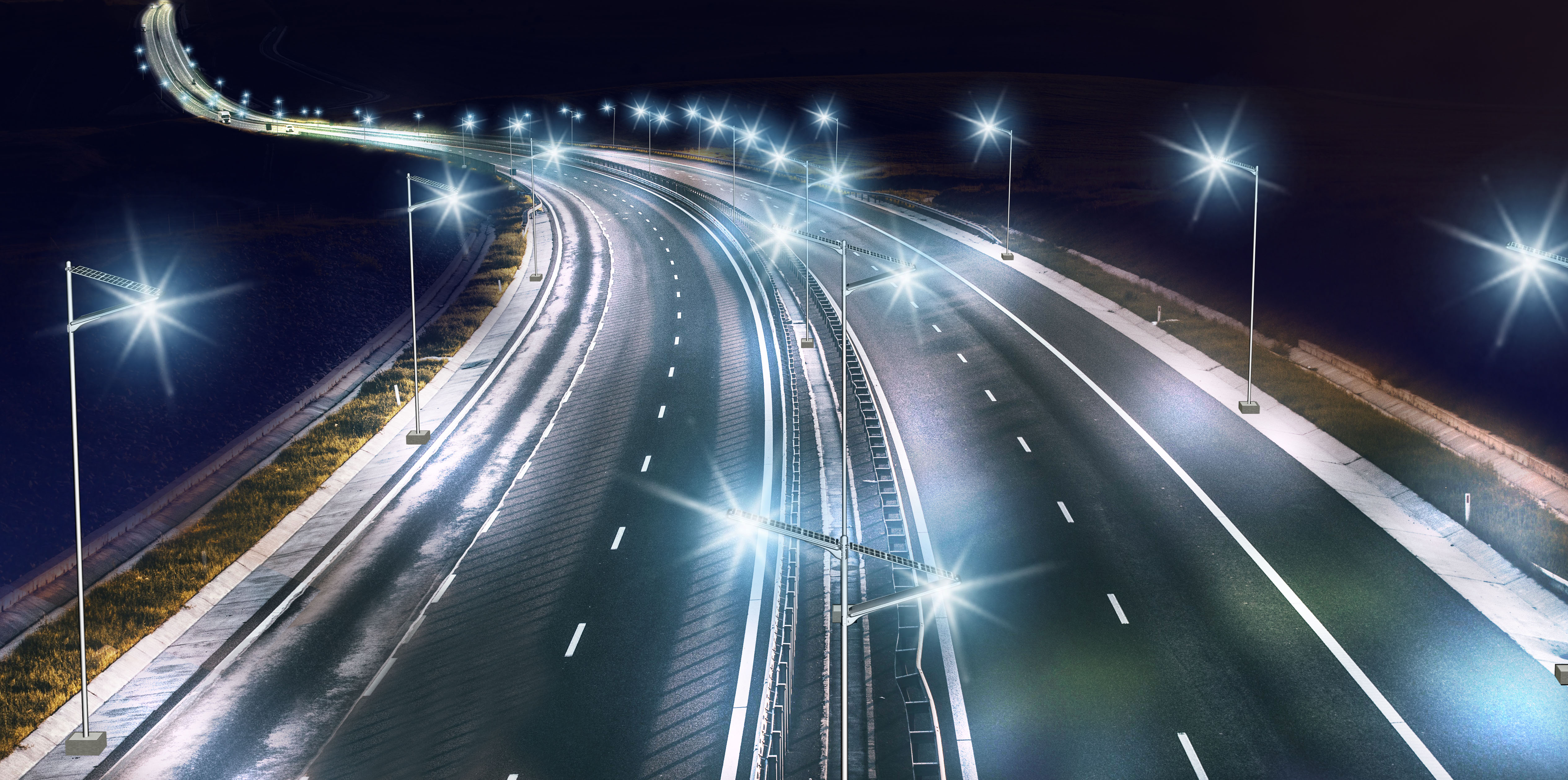
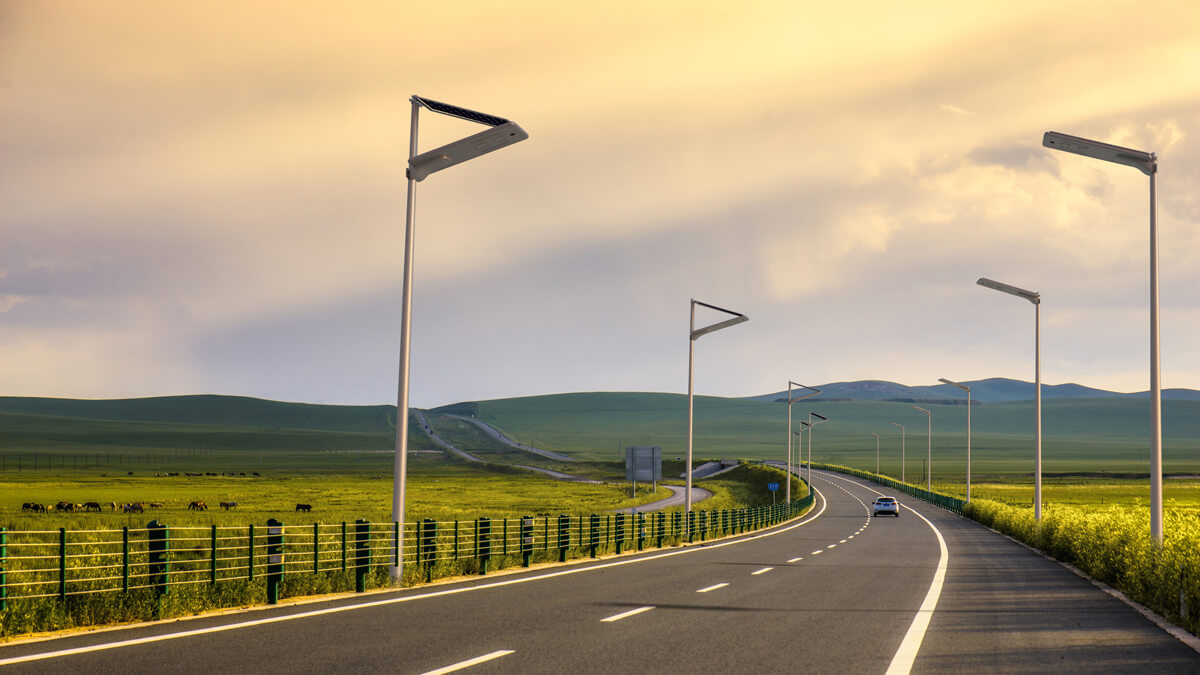
Road Construction / Highway Service Area Solar Street Light. Highway service areas and highway corridors require high luminous flux and wide spacing. The ML-Split-120 split solar street light combines a 120 W solar panel with a 45 W LED and a 45 Ah LiFePO4 battery, supporting an 8–10 m installation height and 30–35 m spacing. For 10 m poles, the Vertical Solar Wrapped Light Pole ML-VSWLP-10 integrates 720 W of heterojunction solar modules (6×120 W) in the pole structure and powers double 45 W LED arms, with a total 84 Ah LiFePO4 battery bank. This design removes the need for a separate solar panel mounted on top of the pole.
Rural Road Solar Street Light. Rural roads typically have lower traffic volume and narrower widths. The Palm Series foldable all-in-one solar street light provides compact, fast-deployable lighting. ML-PALM-100 uses a double-sided 140 W monocrystalline panel, 100 W LED at 200 lm/W, and a 45 Ah battery, with a recommended 8 m mounting height and 25–30 m spacing. ML-PALM-64 uses an 80 W panel and 30 Ah battery for a 6 m mounting height and 20–25 m spacing.
Coastal / Seaside / Port Road Lighting. Coastal environments demand corrosion resistance and water ingress protection. The Palm Series is rated IP67 and carries certifications including CB, CE, IK10, FCC, SGS, COC, and NSS. Project records include 380 units of Palm Series 120 W installed on a seaside road in Qatar and 280 units of Palm Series 100 W at a port road in the Philippines.
Dusty / Desert Road Environments. In desert or dusty environments, panel soiling can reduce energy yield. The ML-CL-80 Auto-Clean All-in-One Solar Street Light incorporates an auto-clean system to mitigate dust accumulation. It combines a 100 W panel, 80 W LED at 200 lm/W, and a 45 Ah LiFePO4 battery, with a 7–8 m recommended mounting height.
Road Surveillance Sections. For road surveillance, Cmoonlight also offers 4G solar CCTV camera systems. The ML-C40W-4MM uses a 40 W solar panel, 35 Ah LiFePO4 battery, and a 2-megapixel 4G dome camera; the ML-C200W-18Z uses a 200 W panel and 100 Ah battery with an 18× zoom camera. These are paired with road lighting poles to enable 24-hour monitoring without trenching.
Step-by-Step Breakdown: How to Evaluate and Select
- Define the project scenario. Identify road type, traffic volume, road width, climate, sunlight availability, and operating hours.
- Select lighting architecture. Choose between split, integrated, all-in-two, or pole-integrated architecture based on maintenance access, installation speed, and aesthetic requirements.
- Check mounting geometry. Match pole height, arm length, and pole diameter. Cmoonlight lists recommended pole diameters such as 60–65 mm or 60–72 mm depending on model.
- Specify energy autonomy. Determine required backup days (3–5 rainy days for most Cmoonlight models) and nightly illumination time (12 hours with dimming modes).
- Select smart control. Choose light/time/microwave sensor control, auto-dimming, and auto-clean features. Inductive (microwave) sensor control allows lights to operate at 100% output when people or vehicles are present and dim to 30% after they leave.
- Verify durability and certifications. Confirm IP66/IP67 waterproofing, IK10 impact resistance where needed, and the ability to operate in a wide temperature range from -20°C to 60°C.
- Review manufacturer capability. Evaluate OEM/ODM customization, monthly capacity, quality control, lead time, and warranty. Cmoonlight’s monthly capacity is 8,000 units, lead time is 15–45 days, MOQ is 2 units, quality control includes 100% testing, and after-sales support provides a 5-year replacement warranty.
Use Cases from Real Installations
The following project records show how product families are placed into specific scenarios. All listed cases are drawn from Cmoonlight’s installation history and report stable operation with no brightness decrease over the project duration.
- Highway lighting, Saudi Arabia: 380 units of 10 m Vertical Solar Wrapped Light Poles; stable operation for 10 years.
- Highway lighting, Oman: 1,580 units of 10 m Vertical Solar Wrapped Light Poles.
- Highway lighting, UAE: 2,280 units of 10 m Vertical Solar Wrapped Light Poles with double arms.
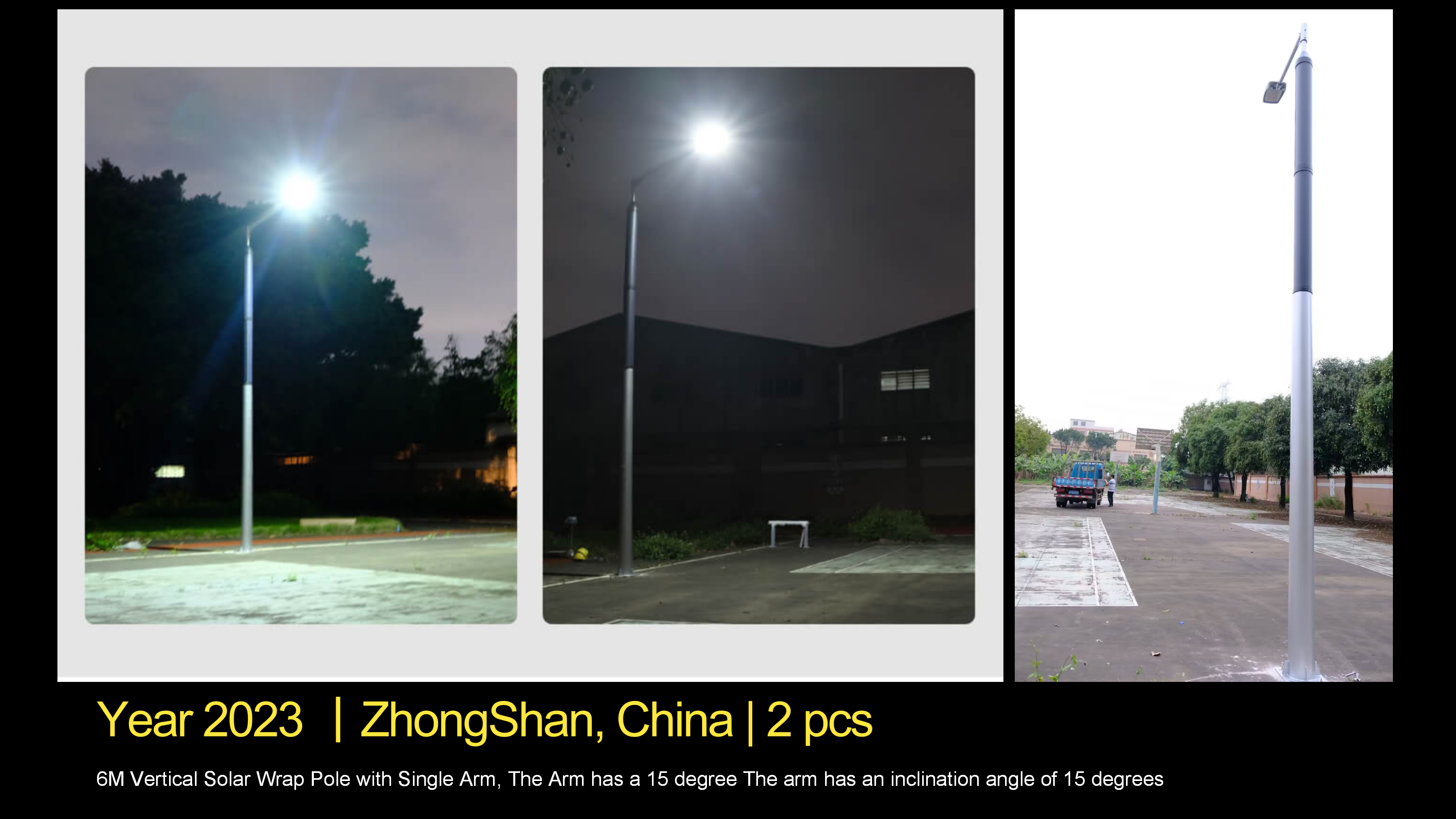
- Rural road lighting, China: 280 units of 6 m Vertical Solar Wrapped Light Poles.
- City road lighting, Peru: 1,800 units of Palm Series 120 W foldable all-in-one solar street lights.
- Rural road lighting, Malaysia: 400 units of Palm Series 100 W foldable all-in-one solar street lights.
- Highway lighting, Mexico: 480 units of ML-Split-120 split solar street lights.
- Road surveillance, Philippines: 60 units of 40 W 4G solar CCTV cameras.
Comparison Table: Recommended Models by Project Scenario
The table below summarizes typical Cmoonlight product selections for different project scenarios. It is intended as a starting point; final selection should be validated with the manufacturer using site-specific data.
| Scenario | Recommended Model | LED Power | Solar Panel | Battery | Mounting Height | Spacing | Key Feature |
|---|---|---|---|---|---|---|---|
| Urban Main Road | ML-ST-120 | 120 W | 150 W | 45 Ah | 8–9 m | 30–35 m | Adjustable ST series, 200 lm/W |
| Urban Main Road / Highway | ML-ST-200 | 200 W | 280 W | 45 Ah (25.6 V) | 9–10 m | 30–35 m | High brightness, Cree chips |
| Highway / 10 m Pole | ML-VSWLP-10 | 2×45 W | 6×120 W (720 W) | 84 Ah | 10.27 m | N/A | Pole-integrated PV |
| Highway / Service Area | ML-Split-120 | 45 W | 120 W | 45 Ah | 8–10 m | 30–35 m | Split design, 200 lm/W |
| Rural Road | ML-PALM-100 | 100 W | 140 W | 45 Ah | 8 m | 25–30 m | Foldable, IP67 |
| Rural Road / Low Height | ML-PALM-64 | 64 W | 80 W | 30 Ah | 6 m | 20–25 m | Foldable, IK10 |
| Dusty Areas | ML-CL-80 | 80 W | 100 W | 45 Ah | 7–8 m | 20–30 m | Auto-clean system |
| Community / Parking | ML-ST-80 | 80 W | 100 W | 30 Ah | 7–8 m | 25–30 m | Motion sensor |
FAQ
Cmoonlight’s Palm Series foldable all-in-one solar street lights carry CB, CE, IK10, FCC, IP67, SGS, COC, and NSS certifications. Other integrated and split models are designed with IP66 or IP67 waterproof construction and operate across a wide temperature range from -20°C to 60°C for outdoor use. When selecting a supplier, confirm that the specific model for your project has the required ingress protection and impact rating for the installation environment.
Yes. Cmoonlight supports OEM/ODM customization of solar panel wattage; battery model, capacity, and voltage; hybrid solar and grid power functions; smart street light systems; light efficiency; color temperature; and lighting mode. The factory’s monthly capacity is 8,000 units, and its R&D team includes 25 engineers, allowing technical adaptations beyond standard catalog products.
The main cost drivers are LED power, solar panel size, battery type and capacity, controller features, and optional systems such as auto-cleaning and smart sensors. Higher-wattage models for main roads require larger panels and batteries than lower-wattage residential models. Requesting a spec-matched quote avoids paying for unnecessary capacity while ensuring the system meets the required illumination and backup days.
Cmoonlight’s MOQ is 2 units, which allows buyers to evaluate product quality and performance before scaling. This low MOQ is useful for contractors who need to verify installation fit, brightness, and control behavior on site. Contact the sales team with your project parameters to request a sample quotation.
Lead time is 15–45 days depending on product configuration and order volume. To secure a project timeline, send your bill of quantity and technical requirements for a lead-time confirmation. You can reach Cmoonlight at info@cmoonlight.com or WhatsApp +86 18823328907 for a project-specific response.
Conclusion
Project-scenario matching is the most reliable way to evaluate solar street light manufacturers. It shifts the conversation from generic brand claims to measurable parameters: luminous efficacy, battery autonomy, ingress protection, mounting geometry, and real installation evidence. Cmoonlight supports this evaluation process with documented product specifications, OEM/ODM customization, and multi-country project references. When you define your road type, climate, and operating requirements, you can compare suppliers on the criteria that actually determine project success.
Have Questions or Need More Details?
Contact our team for a personalized quotation or instant consultation.
Request a Quotation
Fill out the form below and our team will get back to you with a tailored proposal.
WhatsApp Direct Chat
Prefer to chat in real-time? Message us on WhatsApp for instant assistance & quick answers.
- Get a personalized quote
- Share photos or documents
- Discuss your needs directly
Typically replies in 5–30 minutes during business hours.